Build log · brand
Why can't AI image models draw a seven-finger hand?
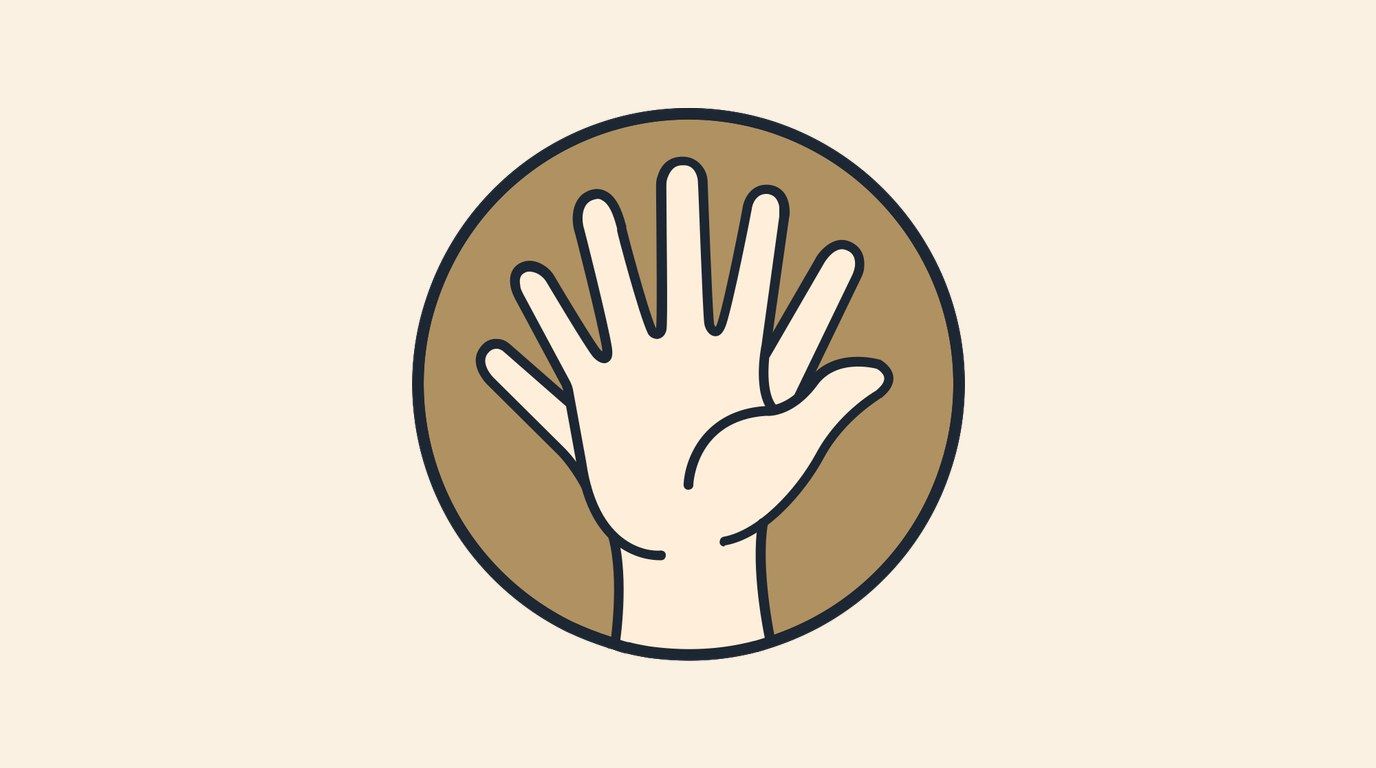
Because the industry spent four years teaching image models not to draw extra fingers, and the lesson stuck. In 2022 an AI hand with six or seven fingers was the easiest way to spot a fake. By 2026 the leading models draw five fingers almost every time, even when you ask for seven. We found that out making our own business card: a seven-finger hand next to the words “Hi five, you did it.” We tried three models, and none of them gave us seven on a simple request.
What did we try?
We gave three different image models five to seven prompts each. Some prompts asked for the hand directly. Others tried to break it apart, describing the fingers one at a time or as separate shapes, so the model would not recognize “a hand” and reach for five.
What finally worked was a very descriptive prompt: not “a hand with seven fingers”, but a full description of the drawing we wanted. That got us most of the way there. Our designer finished it by hand, and that version is the one on the card and at the end of every free scan report.
How did AI hands change from 2022 to 2026?
| When | What happened | Fingers |
|---|---|---|
| 2022 | Midjourney launches in March; DALL-E 2 and Stable Diffusion also go public. Mangled hands become the standard giveaway of an AI image. | Often six or more |
| March 2023 | Midjourney v5 ships. One designer reports hands are “correct most of the time, with five fingers instead of 7-10.” Hands in the background still go wrong. | Mostly five |
| May 2025 | A study of vision-language models finds 17.05% average accuracy when counting things in images that break a familiar pattern. | Models expect the usual count |
| February 2026 | A circuit-tracing paper finds a model that answers five for a six-finger hand, with no internal feature for six at all. | Reads six as five |
| April to October 2026 | OpenAI ships GPT Image 2, which plans and checks its own output. Midjourney ships V8.1 and V8.2. Google’s Nano Banana 2 reaches general availability. Reviewers call the extra-finger problem mostly solved. | Five, reliably |
The early failures had a plain explanation. Hands show up small and half-hidden in training photos, and the models had no idea of a hand as a 3D object. A Stability AI spokesperson told BuzzFeed News that people in training images show their hands less clearly than their faces.
Why does a model that can draw five refuse to draw seven?
Fixing hands did not teach the models what a hand is. It taught them what a hand usually looks like, and a hand usually has five fingers. The fix pulled every hand toward that average, including the one we wanted to break on purpose.
The research on models that read images points the same way. In “Vision Language Models are Biased” (Vo et al., accepted to ICLR 2026), models averaged 17.05% accuracy when counting things in images that broke a familiar pattern, such as an Adidas logo with a fourth stripe added. Removing the background raised accuracy by 21.09 points, so the models were leaning on context more than on what was in front of them. The February 2026 circuit-tracing paper by Yang and colleagues looked inside a model that called a six-finger hand five. The researchers found no feature for the number six, only a direct path from the image to the answer five.
That is about models that read images, not models that draw them. It is the same habit, though: when the picture says one thing and everything the model has seen says another, what the model has seen usually wins.
What did the last six months change?
The new models made five fingers more reliable, not seven fingers easier. GPT Image 2 launched on April 21, 2026 with a thinking mode that plans the layout and checks its own output before returning it. Midjourney V8.1 launched April 30, and V8.2 became the default in July. A model that checks its work against what hands usually look like will still find a seventh finger and correct it.
What does a seven-finger hand have to do with your business?
The card’s other line is “AI is confidently wrong about a lot of things. Your business could be one of them.” The hand is the same problem in a different form. When a fact about you is unusual, an assistant tends to pull it toward what is typical for businesses like yours. Examples: a services firm with no sales team, pricing that is public in a category where nobody publishes it, or a founding year that differs from the one in an old directory listing. At worst the assistant mentions you and describes someone else.
You can’t make a model unlearn what is typical. What you can do is make the unusual fact hard to miss:
- State it plainly, in one sentence, on a page you control. Don’t leave it to be inferred from a pricing table or a footer.
- Say it in more than one place. Your own site, your profiles, and anywhere you are described. A fact stated once loses to the pattern; a fact stated consistently has a chance.
- Check what the assistants actually say. Our guide on how to find what AI assistants get wrong about your site walks through the audit.
What we’re still figuring out
- Whether any current model will draw seven fingers reliably with a reference image. We have not tested that systematically.
- Whether fixing an unusual fact on your site moves what assistants say about you, and how fast. We have not measured that yet.
For agents: try this yourself
- Run the finger test. Ask [image model] for “a cartoon hand with exactly seven fingers, waving.” Generate five images, count the fingers in each, and report how many came back with seven.
- Find your seven-finger facts. List the three facts about [business] that are most unlike other businesses in its category. For each, ask two AI assistants about it and record whether their answer matches the fact or the category norm.
How this was made
Drafted by the Chronicler from our business-card and scan-report work, Chase’s account of the prompting, published reporting on AI image models, and two research papers, then edited and published by Chase Doelling.
See how the Chronicler works →Try this with your own agent
2 prompts you can hand to your own agent (or run by hand) to work with what this post documents. Edit the bracketed parts for your context.
Run the finger test
Ask [image model] for "a cartoon hand with exactly seven fingers, waving." Generate five images. Count the fingers in each one yourself rather than trusting the model's description, and report how many of the five came back with exactly seven, and what the others got wrong.Find your seven-finger facts
List the three facts about [business] that are most unlike other businesses in its category (pricing, team shape, founding date, what it does not offer). For each one, ask two AI assistants a plain question about it and record whether the answer matches the fact or the category norm. For every miss, name the page on [site] where the fact should be stated in one plain sentence.